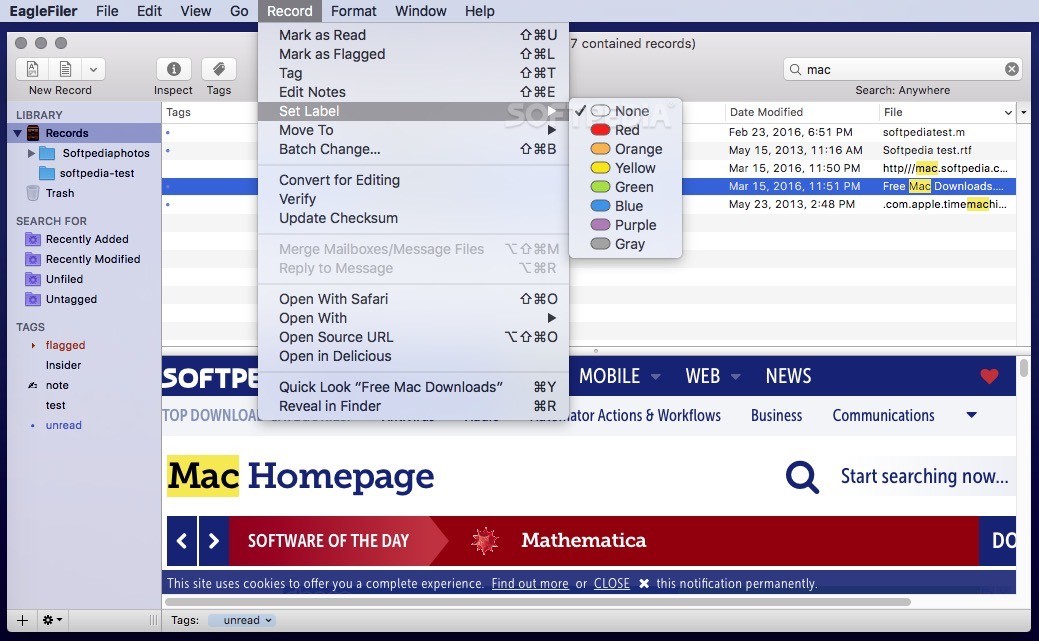
EagleFiler is a program that makes managing all the information you receive easy. EagleFiler lets you archive and search mail, Web pages, PDF files, word processing documents, images, and more. Use it to collect information from a variety of sources.
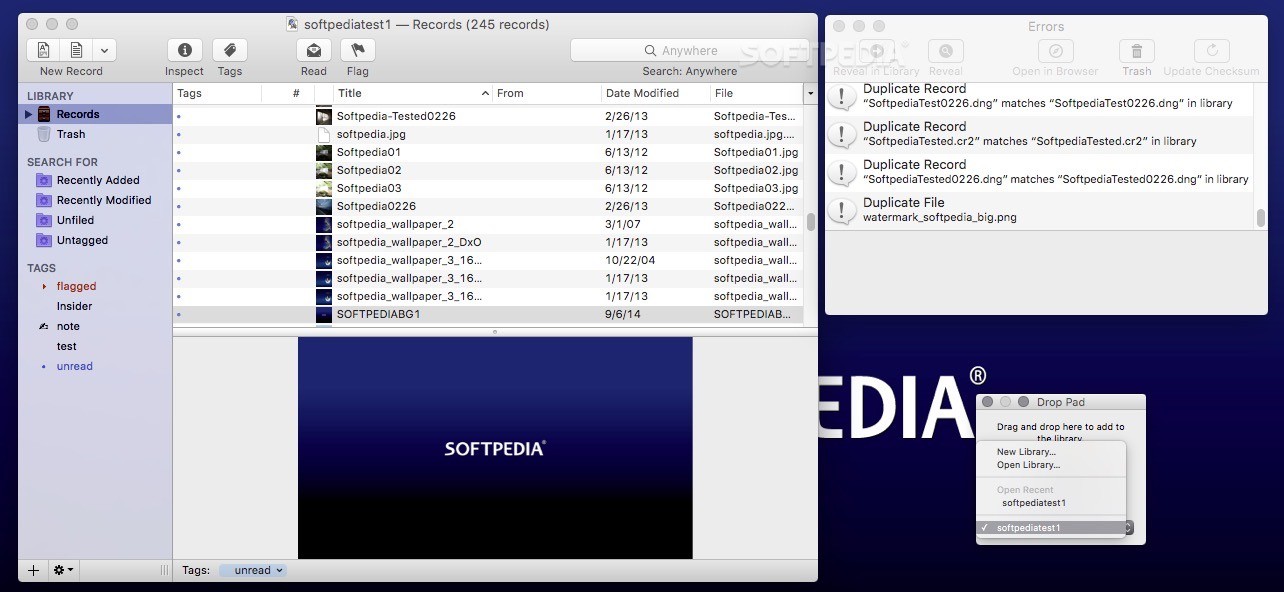
Browse different types of files using a standard three-pane interface. Organize them into folders and annotate them with tags and notes, or leave everything in one folder and pin-point the information you need using the live search.
Since EagleFiler stores its library in Finder format, you can use it in concert with the other tools in your Mac ecosystem.
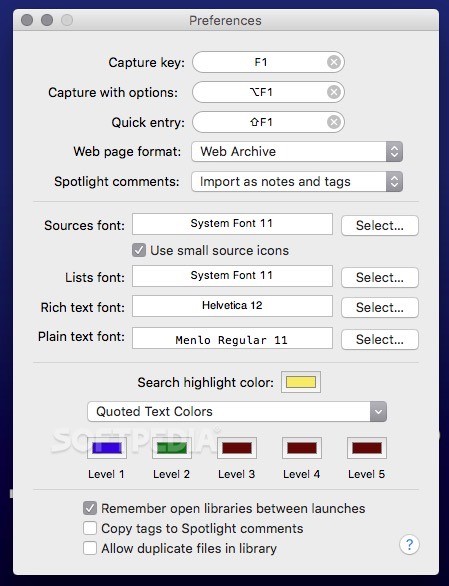
Getting your information into EagleFiler is easy. When you're viewing a Web page in Safari or NetNewsWire, looking at a mailbox in Mail, or browsing files in the Finder, just press the capture key (F1 by default).
EagleFiler will save the document into its library, and you can go right on working without interrupting your flow. (Of course, you can also use drag and drop or other methods if you prefer.)
Once the document is in EagleFiler, you'll always have a copy of the way it looked when you imported it. No more bookmarking a great article, only to find out later that the page is no longer available or that registration or even payment is now required.
If you do research on the Web, you know that pages change-sometimes without notice-so it's always good to keep a paper trail of exactly what you read.
Considering that today's Macs ship with tens or even hundreds of gigabytes of storage there is absolutely no shame in being a digital pack rat.
NOTE: To buy EagleFiler via the App Store an Apple account is required.
Here are some key features of "EagleFiler":
General:
· Easy to install: just drag and drop a single application file. There’s no need to install a database engine, plug-ins, or script files to integrate with your other applications.
· Easy to use, with a familiar three-pane interface—lots of power, without lots of cluttered options.
· Makes efficient use of RAM and disk space.
· AppleScript support, for automation and integration with other applications.
Importing:
· Can import any kind of file. EagleFiler has special support for displaying most common formats, and it can use Quick Look to display the others.
· Just press a hotkey while in another application, and EagleFiler will intelligently import the Web page, mailbox, or file that you’re currently viewing.
· Press the Quick entry hotkey to create a new file in EagleFiler from any application.
· Store Web pages in the following formats: bookmark, PDF, PDF (single page), plain text, rich text, rich text with images, Web archive.
· Import from any application by printing and choosing Save PDF to EagleFiler or by saving a file into EagleFiler’s To Import folder or directly into the library’s folder structure.
· Move or save new files directly into the library folder, and EagleFiler will auto-import them when it does a Scan for New Files.
· Import Web pages using bookmarklets.
· Automatically import scans by setting your scanner software (Fujitsu ScanSnap recommended) to save its files in the To Import folder.
· There are many other ways to import (e.g. drag and drop, services) so you can choose whatever’s easiest for the task at hand. Hold down the Option key when importing, and you can choose where to save the file and add tags, notes, and other metadata.
· Automatically detects duplicate files to save disk space and help you see what’s already been imported.
Mail:
· First-class support for archiving e-mail. EagleFiler understands the content of messages and treats them as mail rather than as text or RTF files.
· Import the selected mailboxes or messages simply by pressing a hotkey.
· EagleFiler retains the full message data, including attachments, read/flagged/replied status, and MailTags, so nothing is lost when moving mail into EagleFiler.
· Speed up your mail program by moving older messages to EagleFiler.
· Messages are efficiently stored using the standard “mbox” format and can be imported back into any mail program if desired.
· You can also store messages as individual .eml files, for Spotlight searchability, and you can freely convert between the .eml and mbox formats.
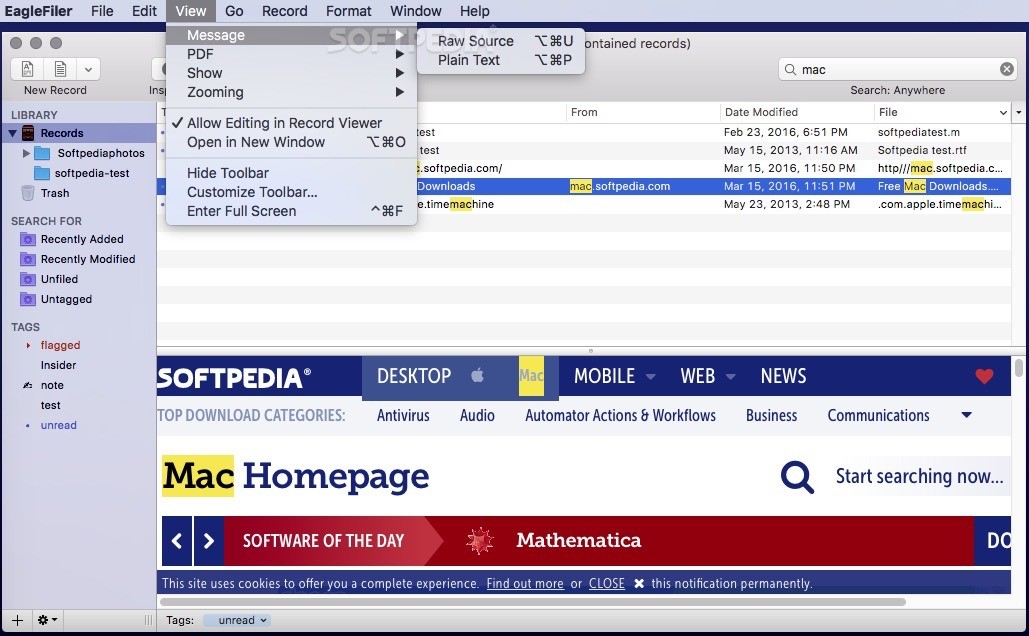
· Can display messages as plain text (with colored quote levels and clickable links) or as HTML.
· Extract your e-mail from a proprietary mail client database and convert it into standard mbox or .eml files.
Organization:
· EagleFiler supports multiple libraries, stored wherever you want (hard disk, iDisk, iPhone, iPad, iPod, USB drive, etc.).
· You can open more than one library at a time, and more than one window per library.
· Files can be organized with folders and tags, both of which can be nested.
· Use the Go menu to quickly jump around to viewing different parts of your library.
Editing:
· Create a new file with a single button or keypress and immediately begin typing. There’s no need to open a new window or go through a Savedialog box.
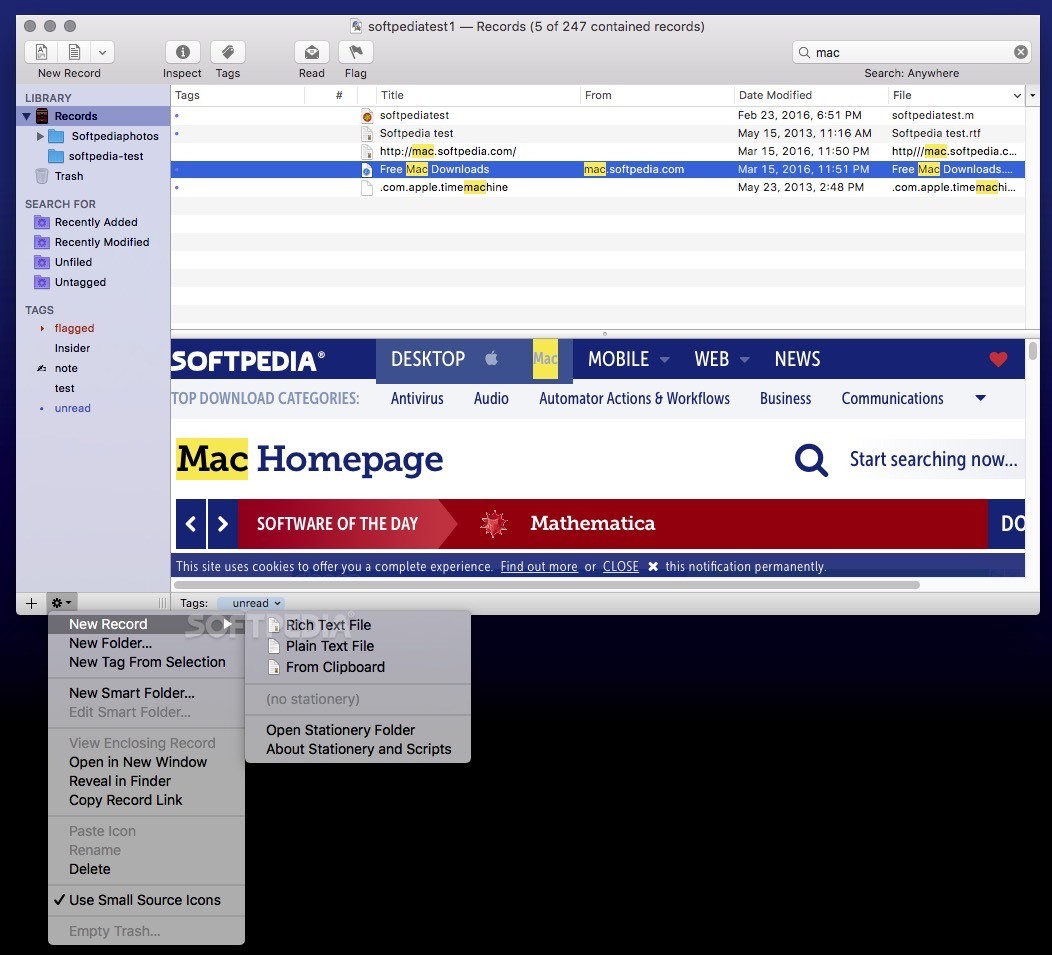
· Use stationery (a.k.a. templates) to quickly create any type of new file. Stationery can automatically trigger AppleScripts to dynamically fill in the metadata for you.
· RTF, text, OpenDocument, and bookmark files can be edited from within EagleFiler. Powerful text editing features include find & replace, spelling and grammar checking, smart links/quotes/dashes, data detectors, automatic text replacement, and case transformations.
· For other types of files (e.g. Word, Pages), just double-click to open them in your favorite editor. The changes are automatically saved back into the EagleFiler library.
Storage:
· Your data and notes are stored in regular files using standard formats (RTF, PDF, Web archive, mbox, etc.), so there’s no lock-in or risk of database corruption, and it plays well with Time Machine.
· Uses MD5 checksums to verify the integrity of all files in the library, for safe long-term archival.
· Metadata (tags, titles, source URLs, etc.) goes into a Core Data SQL database for reliable storage and quick access.
· EagleFiler automatically backs up the metadata and notes to XML property list files. In the rare event that the database file becomes damaged, you can import the files into a new library, and EagleFiler will build a new database and reconstruct all the metadata.
· Can copy tags into OpenMeta and the Spotlight comments field to make them searchable and accessible to other applications.
Encryption:
· Libraries can be encrypted with AES-128 or AES-256 for secure, password-protected storage.
· Encrypted libraries are stored using Apple’s disk image technology, so their contents are accessible on any Mac, whether or not EagleFiler is installed.
· The entire library contents—including the metadata, indexes, and temporary files—are encrypted. Unencrypted data never touches the disk.
· In other respects, an encrypted library works just like a regular one. It’s still fully searchable, and the files are still accessible to other applications (once you’ve entered the passphrase).
Search:
· EagleFiler uses its own optimized indexes so that you can search the contents of your library faster than with Spotlight.
· You can do exact searches across individual fields (title, filename, notes, tags, from, to/cc) as well as searches across the entire file contents.
· Searches can use phrases, wildcards, Boolean AND/OR/NOT, and grouping.
· Do quick tag searches by selecting one or more tags at once.
· Create your own smart folders and organize them into folders. Custom smart folders can contain an unlimited number of criteria, optionally using nested Any/All/None. You can define actions to occur when you drag a record onto a smart folder.
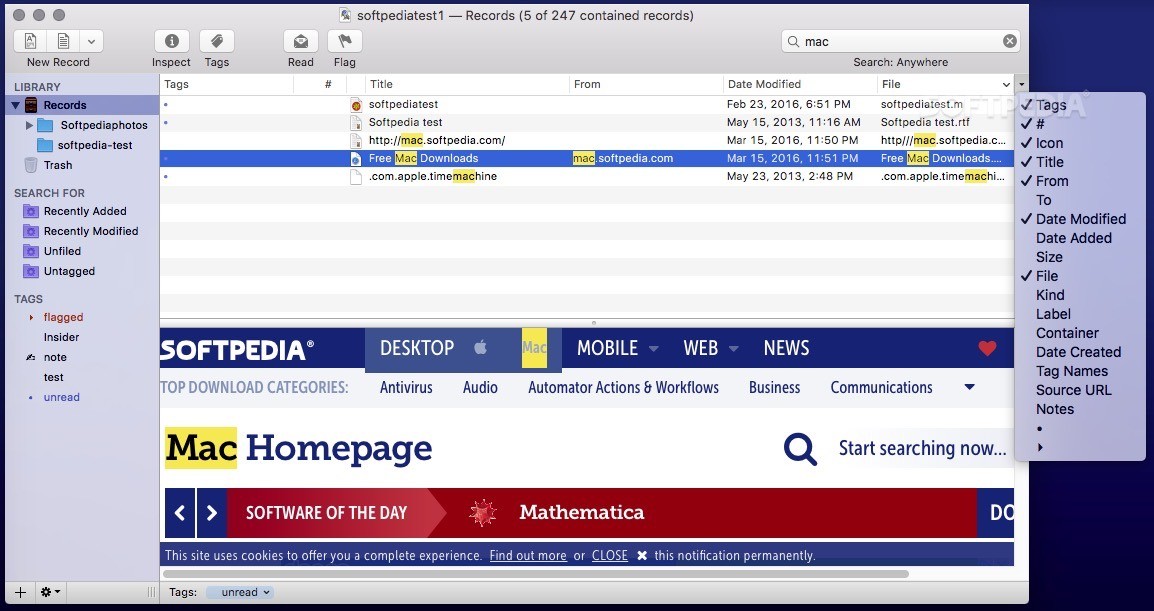
· Matching search terms are highlighted in the document contents and in the records list. Use the Find panel or its keyboard shortcuts to search within a document and to jump from one highlighted occurrence to the next.
· EagleFiler reads most files itself, so it can index text that Spotlight wouldn’t see (e.g. files attached to e-mail messages, invisible Web content,Skim notes attached to PDF files). It automatically takes advantage of third-party Spotlight importer plug-ins to support custom file formats.
· Since the files and notes are stored out in the open, they’re also searchable with Spotlight (for when you want to search your entire Mac at once), without the need for stub files in the Caches/Metadata folder.
· EagleFiler’s search indexes are immediately available after syncing, restoring from a backup, or transferring your files to a new Mac; there’s no need to wait for it to reindex, as with Spotlight.
Metadata:
· For each file, EagleFiler records the document title, author/from, and source URL.
· You can assign tags (a.k.a. keywords). Tags can have abbreviation symbols and colors, and they can be nested. Quickly assign tags by typing (with auto-completion), drag-and-drop, or by clicking on them in the Tag Cloud.
· The Tags column in the records list compactly shows the abbreviation symbols for all the assigned tags.
· Each file or mail message can have notes, which can include rich text, clickable links, images, and tables.
· Each file and folder can have a colored label, which also shows up in the Finder.
· You can copy links to EagleFiler records and paste them into notes or RTF files, or into other applications.
· When importing via the capture key, EagleFiler can preserve metadata (e.g. tags, notes, titles, URLs) from the source application. This is often higher fidelity than using that application’s own export feature.
· When importing an existing file, EagleFiler can import tags and notes from the file’s Spotlight comments.
· EagleFiler can display and search Skim notes attached to PDF files.
Limitations:
· 30 days free trial period.
What's New in This Release: [ read full changelog ]
· The contextual menu Set Filename/From/Title commands are better at handling linebreaks.
· It is now possible to move records to the trash by pressing Delete when multiple tags are selected in the source list.
· The text fields in the smart folder editor make better use of the available window width.
· Improved the Importing Mail From Outlook section of the manual.
· Added the Importing Mail From MailMate section of the manual.
· Improved the What information should I include when I report a problem? section of the manual.
· Documented the TextInspectorBarStayOpen and UseOpenMetaRecentsForCompletion esoteric preferences.
· Worked around a WebKit bug that could cause freezes when highlighting matching search terms.
· Worked around a bug in Apple Mail that could lead to importing two copies of certain messages.
· Worked around a problem where broken Mac OS X installations couldn’t report full error information.
· Fixed a bug that could cause uncommitted changes in the tags bar to be lost.
· Fixed a bug that ...