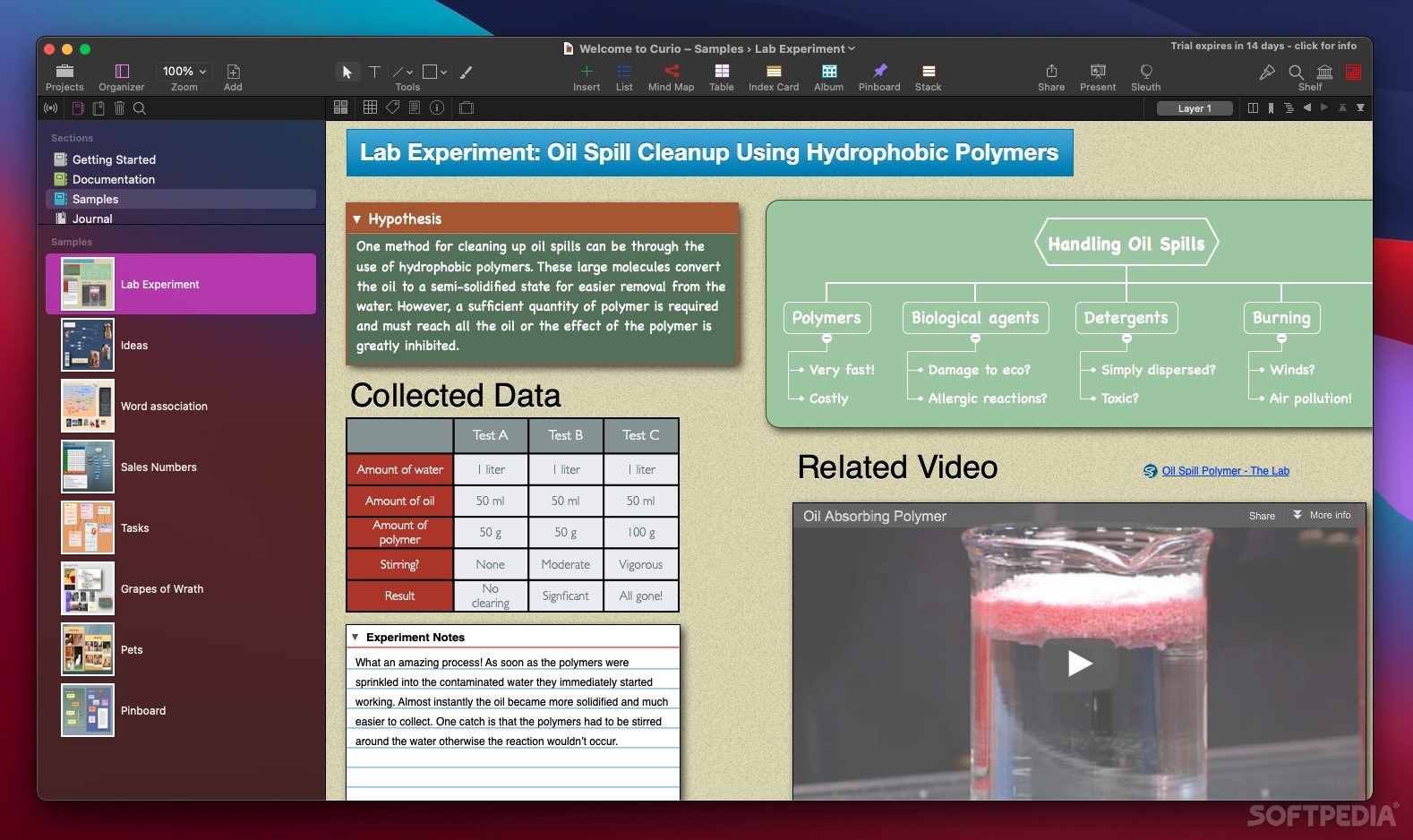
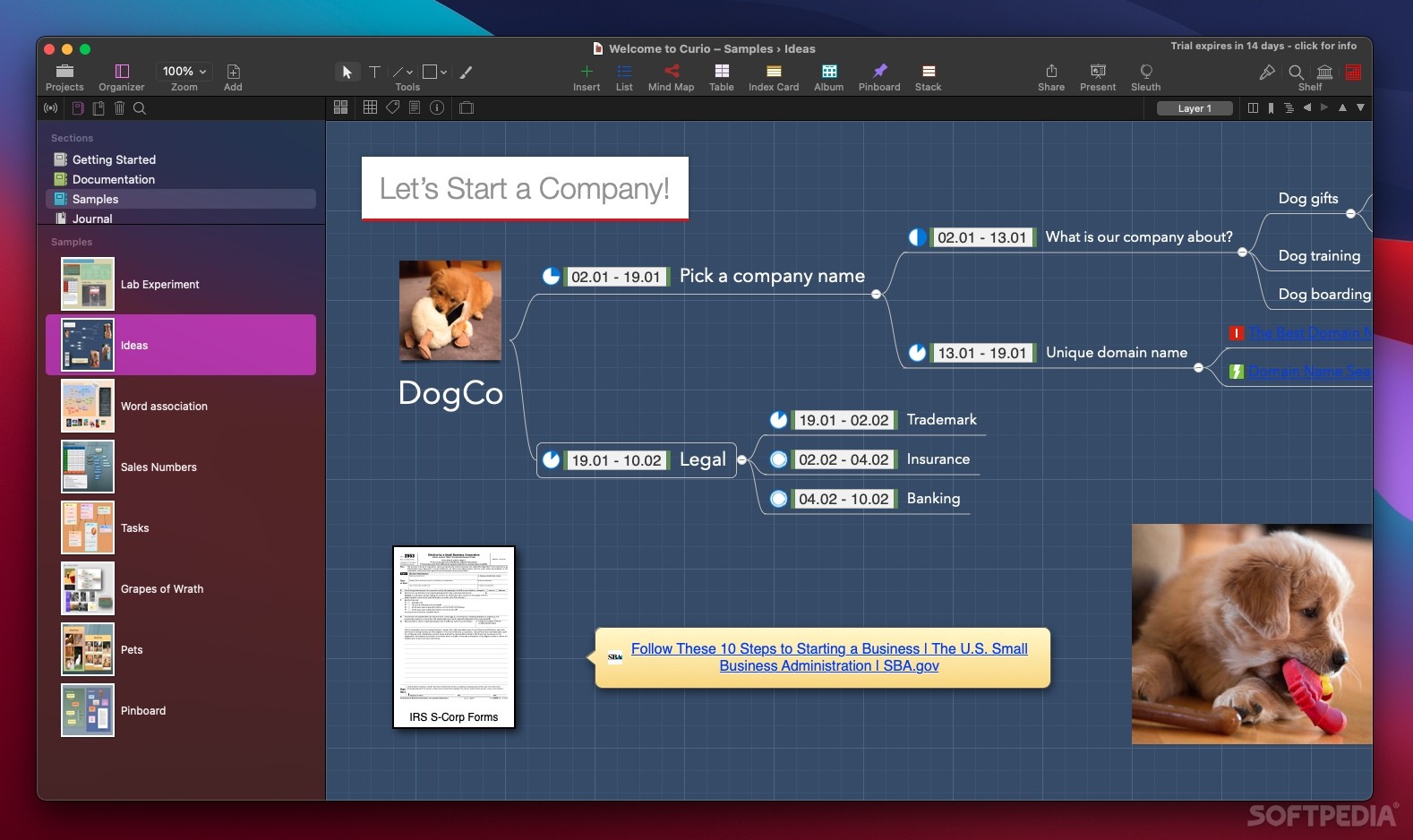
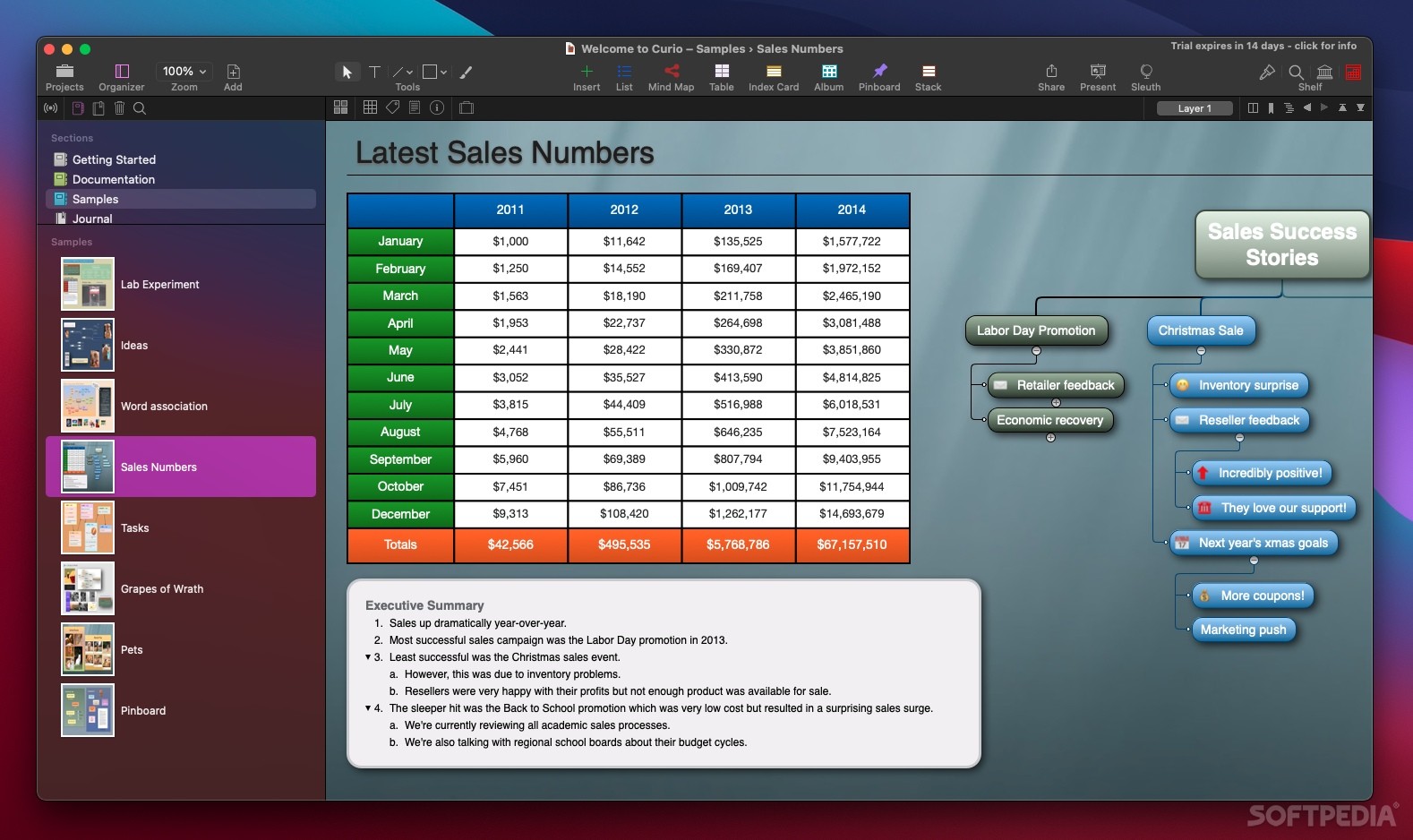
Curio provides the most flexible and powerful environment for gathering and shaping your ideas. No other product on the market has the features and the intuitive interface to promote creative exploration.
Unlike notebook-style applications, Curio lets you place anything anywhere on the page.
Curio lets your mind run wild with an unlimited number of creative idea spaces. Create freeform collages of text snippets, images, movies, and sounds. Grab URL's, images, and text from the web, or files and documents off your hard disk.
Need to sketch out an idea? Curio's amazing brushes and pens allow you to create dazzling drawings and quick doodles anywhere on the page.
Tablet users will find creative nirvana as many of the brushes are pressure-senstive, changing their color saturation and brush size on-the-fly as you press harder on the tablet.
Here are some key features of "Curio Pro":
· Surround your ideas with Curio's flowcharting and mind mapping shapes!
· Curio's group, text, and asset figures can be framed with rectangles, rounded rectangles, octagons, hexagons, trapezoids, brackets, vertical brackets, triangles, diamonds, semicircles, ovals, and clouds.
· Many shapes can be further customized turning brackets into parentheses and clouds into super-bumpy clouds.
· Create outline lists and check lists! Any type of figure can be in a list: text, assets, images, movies, bookmarks ... anything!
· Figures can be easily rearranged and indented (via tab and shift-tab or via drag and drop within the list). You can also apply an optional outline style for creating various types of bulleted and numbered lists. Combined with the flags, checkboxes, and ratings (all described below) you can easily create Top 10 lists and To Do lists.
· With Curio's advanced grid you have control over the vertical and horizontal grid snapping.
· Curio now includes new grid styles such as notebook, college-ruled, legal, quadrille, and engineering papers.
· When using one of the notebook-style grids, text line height is automatically set to match grid height to complete the notebook paper look.
· Figures within Curio can be tagged with one or more built-in graphical flags to make certain items stand out. A checkbox flag can also be added which can be checked and unchecked. And rating stars can be displayed to quickly see the top-rated items. Fill an idea space with new company names or logos and, with a quick click, flag them so the winners are separated from the losers.
· Have you ever wanted to create a quick embedded TextEdit document or Photoshop drawing while brainstorming in Curio? To do this in the past you've had to leave Curio, launch the other application, do your work, save the file, drag that file into your Curio project marking it as embedded, then delete the original file. Whew! But no longer! Now you can easily create an embedded document for any application. Curio comes bundled with several default templates for TextEdit, Photoshop, OmniGraffle, OmniOutliner, and others, and you can easily add your own document files as templates.
· The Curio paint brushes and pens will change their brush size and color saturation with pressure while you're scribbling on a tablet. The opacity stays set to the value specified in the Inspector. This combines the best of Apple InkPad (size and saturation change with pressure) and Adobe Photoshop (opacity can be set for a brush). It now feels much more like you're scribbling on a real-world sketchbook!
· The Library has been integrated into the main project window as a separate collapsible pane. Searching via the toolbar's search field now updates the Organizer, current idea space, and Library panes. You can also display additional sortable columns including date created, date modified, date added (to Curio), rating, preview image, whether the asset has an associated note, use count, and size in bytes. The Library can also show you where an asset is used in your project and allow you to quickly open an associated idea space. It's awesome!
· Sleuth comes pre-loaded with tons of amazing reference sites, photo archives, quote services, font foundries, and other fun sites. But what if you have a particular site that you want to search that Sleuth didn't include?
· No problem! Drag and drop a search result page from Safari or other browser and Sleuth will fill in the details automatically. For search sites that use POST you'll need to do some digging on your own to find out what's needed but Sleuth's interface makes it easy to set up the Sleuth site once you have that info.
· The Dossier component of Curio contains an incredible collection of customizable question and answer templates to help you get started on your project. Choose Creative Brief for your graphic or print design needs, Video Production for your next video project, and Product Plan when planning a new product, service, or company.
· Other templates include Screenplay for your cinematic aspirations, Science Experiments for classroom lessons, and Essay for your creative writing assignments.
· You can publish your project, or just selected idea spaces, to your .Mac iDisk to share with anyone! Your idea spaces are exported using Curio's wonderful HTML exporter (see below) then uploaded to your iDisk. In fact, multiple projects can be published simultaneously in the background while you continue working with Curio.
· Curio will make sure only changed idea spaces and assets are exported since your last publish to maximize efficiency.
· You can export your Curio idea spaces as PDF's, TIFF's, PNG's, JPG's, or even HTML. The HTML support is simply amazing: idea spaces are exported as images along with all assets associated with those idea spaces. Asset figures found on the rendered idea space can be clicked on to instantly download documents, movies, and songs, loading them within the browser if appropriate. Web URLs and jump markers also work as you would expect taking you to the web site or idea space. Check out our Feature Tour sample Curio document exported as an HTML project.
Limitations:
· 15 days trial period. After the trial period you can view and print your projects but you will no longer be able to save, export or publish.
What's New in This Release: [ read full changelog ]
Curved and Orthogonal Lines:
· Curio now supports curved and orthogonal lines! Just right-click on a multipoint line to select a new line type via the context menu, or change the line type in the Figure inspector. You can drag your midpoints around to change the shape of the spline curve or orthogonal control points.
On-The-Fly Multipoint Lines:
· You can still right-click on an existing line to add midpoints but now we've added an even faster way to create multipoint lines.
· Grab the line tool and click to start the first point, then drag to place the endpoint. But before you release the mouse button hold down the Option key. When you release the mouse you'll find that you've dropped a midpoint and now you're placing a new endpoint. Continue holding down Option to keep dropping midpoints as you release the mouse. If you're done, just release the Option key before you drop your last point.
· Since we're using the Option key for this that means we've taking away the normal modifier to create a non-sticky endpoint. So, the Control key is now used for that operation: just hold Control while dragging a point so you can place it over an existing figure without sticking to the figure.
Index Card Enhancements:
· Copying multiple selected figures as text or exporting them to text will now grab them in scanline order instead of basing the export on z-order. This means top to bottom, left to right. So you can now lay out your index cards in a rough matrix or grid and they should output as text in an expected order.
· You can now change the location of an index card's title and body figure's flag adornments using the little circular slider in the Adornment Options inspector panel.
· The index card body lines are now drawn under the body figure's text. However, any flag adornments are drawn off to the side with no lines underneath (looks nicer that way).
· You can no longer drag items out of an index card, although you can still cut or copy. Instead, when you try to drag the title or body text of the index card the index card itself will be dragged. This should make it much easier to stack and rearrange cards without accidentally dragging content out of a card.
· If you resize an empty collection figure —including index cards— then Curio will store that size as the default size for future collections of that type. Note the title is ignored when determining if the collection is empty.
Other Features:
· You can now change the location of an table cell's flag adornments using the little circular slider in the Adornment Options inspector panel.
· Greatly increased mind map layout and rendering speeds for many complex mind maps.
Notable Fixes:
· Fixed several issues where figure styles were being reset to default style in tables, lists, mind maps, and index cards.
· We're now making sure all lines drawn in tables, etc, are nice and sharply defined.
· Curio is now much, much, much more memory efficient when printing or exporting to PDF.
· Fixed a bug where lines couldn't stick to specific positions on multipoint lines.
· Fixed problems where tag use counts could become out of sync thereby showing an inappropriately large number of active uses for a specific project tag (in File > Project Properties > Tags).
· When sending a stencil or idea space template to a friend to Zengobi we're now stripping tags from those items before sending.