
A smooth-running and trustworthy application capable to monitor and display the recorded temperature of various sensors in your Mac. #Temperature monitor #Monitor sensor #Display temperature #Temperature #Monitor #Sensor

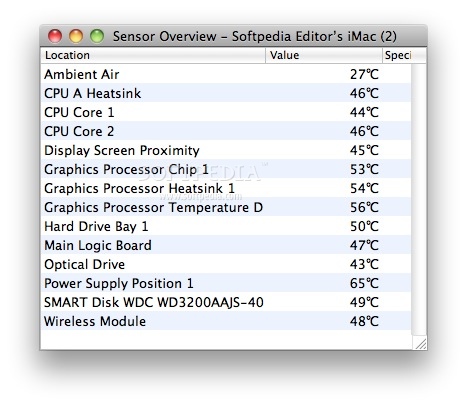
Temperature Monitor is a low-key and user-oriented macOS application specially designed to help you monitor and track the temperature of your Mac’s components.
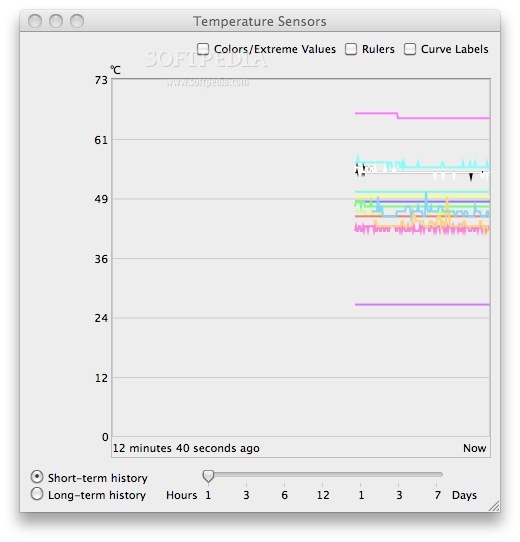
Thanks to Temperature Monitor, you can easily visualize the history graphs of the recorded readings and display the measured values in easy-to-read graphs.
With Temperature Monitor’s help, you can analyze the readings of all monitored sensors and view extreme values along with the sensor limits.
What is more, Temperature Monitor helps you view detailed information about your hard drives, motherboard connectors, processor type, processor and bus frequencies, the S.M.A.R.T state of your hard drives, manufacturing data and more.
You can configure Temperature Monitor to display the read temperature in Kelvin, Celsius or Fahrenheit. Moreover, you can use Temperature Monitor to view the accepted limits of any hardware component.
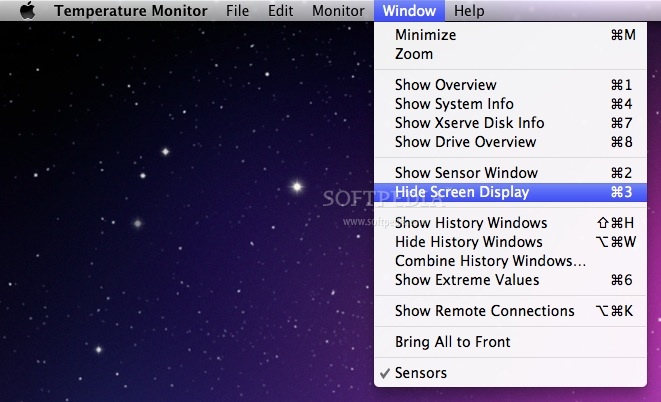
On top of that, Temperature Monitor allows you to monitor the temperature readings on a floating, transparent window that is displayed on your Mac’s desktop. This feature can save you a lot of time, especially when you are working and you don’t want to waste time switching between windows.
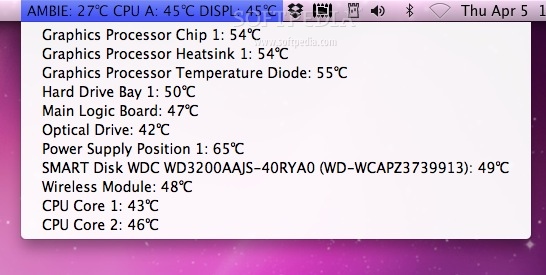
You can view the temperature of any given Mac sensor in Temperature Monitor’s menu bar icon or check the list with all monitor components by accessing Temperature Monitor’s status bar menu.
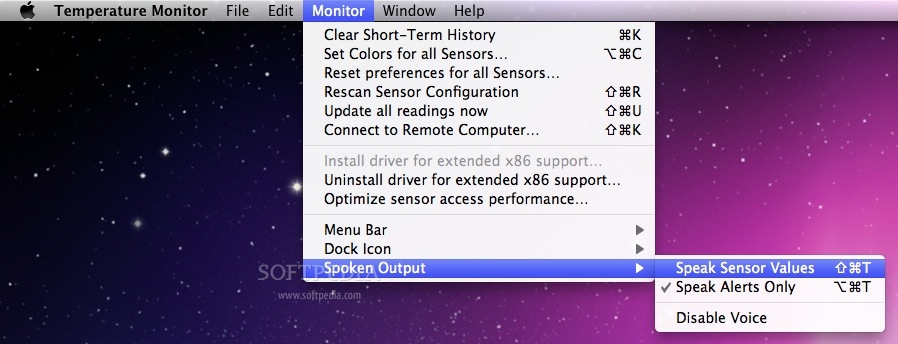
By using Temperature Monitor, you can store an unlimited number of history graphs on your mac and, as a result, track and analyze the hardware temperature evolution for a long period of time. You can also setup Temperature Monitor to deliver temperature readings announcements using audio/voice alerts.
All recorded data and readings can be easily exported to CSV for text files, if you need exhaustive reports on your Mac’s hardware temperature change throughout time. Unfortunately, Temperature Monitor is compatible only with Mac models released between August 2002 and October 2012.
Download Hubs
Temperature Monitor is part of these download collections: Temperature Monitors
What's new in Temperature Monitor 4.98 Build 130919:
- Added support for Growl 2 in addition to Growl 1.
- Several chapters in the reference manual have been revised.
Temperature Monitor 4.98 Build 130919
add to watchlist add to download basket send us an update REPORT- runs on:
- Mac OS X 10.4 or later (PPC & Intel)
- file size:
- 3.5 MB
- filename:
- TemperatureMonitor.dmg
- main category:
- System Utilities
- developer:
- visit homepage
Bitdefender Antivirus Free

ShareX
IrfanView
4k Video Downloader

Context Menu Manager
Zoom Client
Windows Sandbox Launcher
Microsoft Teams
7-Zip
calibre
- Microsoft Teams
- 7-Zip
- calibre
- Bitdefender Antivirus Free
- ShareX
- IrfanView
- 4k Video Downloader
- Context Menu Manager
- Zoom Client
- Windows Sandbox Launcher