
A free and open source package management system for macOS users designed to help manage the installation process of other open source software. #Package manager #Install package #Open source installer #Package #Deployer #Installer
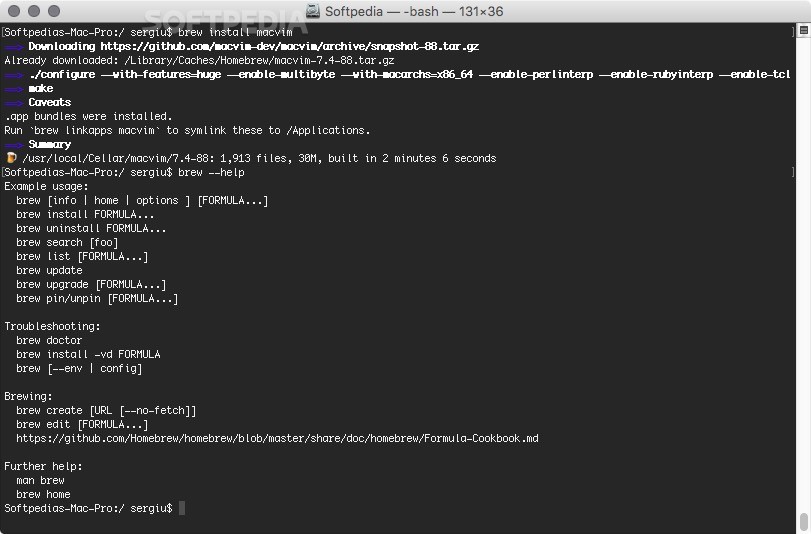
Homebrew is a command line utility designed to streamline the installation of various libraries and utilities that you might need to run certain applications, but have not been included in your macOS installation by default.
The both application provides you with access to a large collection of packages which you can browse using the command line, or by making use of online resources such as the Braumeister website.
To deploy Homebrew on your Mac, you can manually download the source code archive and install wherever you like, or you can run the command provided by the development team in Terminal window (will place Homebrew in the /usr/local folder):
/usr/bin/ruby -e "$(curl -fsSL https://raw.githubusercontent.com/Homebrew/install/master/install)"
Note that on Homebrew's Github project page you can also find detailed installation and removal instructions.
When the installation procedure is complete, the “brew help” command ran in the Terminal will provide you with a list of usage examples, and offer details about other useful commands.
All you have to do is check if the package you need is included in the Homebrew list of supported packages, and then run the appropriate command to install it (“brew install packagenamehere”).
Working with the Homebrew command line utility proves to be very straightforward: the packages are both downloaded and installed with a single command. Homebrew installs each one of them in their own directories and them creates symlinks in the /usr/local/ directory.
Homebrew also enables you to quickly create your own Homebrew packages: as a result, disseminating a dependency required by a certain utility is extremely easy.
To conclude, if you are using open source projects and other types of software that rely on third party dependencies, Homebrew is a great addition to your software collection.
Since the command line utility takes care of both the download and the installation procedures, it should be very useful to both experienced and less seasoned users.
What's new in Homebrew 4.2.18:
- github_runner_matrix: support GitHub-hosted M1 macOS runners by @carlocab in #17042
- cmd/help: add description and arguments. by @MikeMcQuaid in #17045
- dev-cmd/bump-cask-pr: use FromContentLoader when relevant. by @MikeMcQuaid in #17043
- Add more HOMEBREW_FORBIDDEN_* configuration by @MikeMcQuaid in #17037
Homebrew 4.2.18
add to watchlist add to download basket send us an update REPORT- runs on:
- macOS 10.13 or later (Intel only)
- file size:
- 4.3 MB
- filename:
- 4.2.18.zip
- main category:
- System Utilities
- developer:
- visit homepage
4k Video Downloader

Zoom Client

Microsoft Teams
Windows Sandbox Launcher
IrfanView

Bitdefender Antivirus Free

calibre
7-Zip
ShareX
paint.net

- 7-Zip
- ShareX
- paint.net
- 4k Video Downloader
- Zoom Client
- Microsoft Teams
- Windows Sandbox Launcher
- IrfanView
- Bitdefender Antivirus Free
- calibre