
A small but powerful software package designed to boost your online privacy and security by quickly encrypting all DNS packets between your Mac and OpenDNS.. #Encrypt DNS #DNS encryption #Encrypt DNS traffic #DNS #Encrypt #Traffic
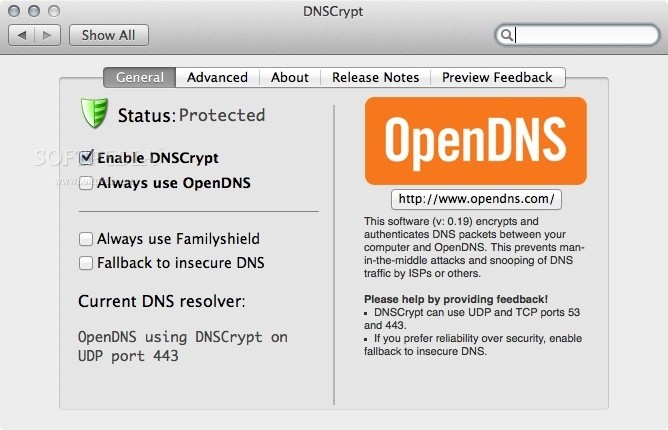
The DNS (Domain Name System) protocol is not bullet proof, especially when it comes to the Internet connection between the ISP and your own computer.
DNSCrypt is a macOS utility designed to encrypt the DNS traffic and block man-in-the-middle attacks, or other security breaches.
DNSCrypt is a collection of shell scripts and can be easily deployed on your Mac by making use of Homebrew: in the Terminal application, simply type the “brew install dnscrypt-proxy” command.
However, there is also a graphical user interface for the utility, which comes with an installer package that reduces the process to following on-screen commands. However, you must restart your Mac to complete the procedure.
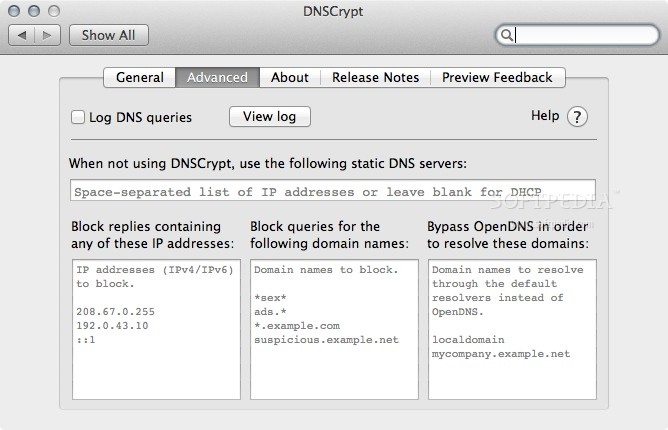
The DNSCrypt GUI is represented by a Preferences pane that can be easily accessed via the System Preferences window. Here you get to quickly enables or disable the service, choose to automatically disable the encryption if blocked, or access the DNS queries log.
At the same time, DNSCrypt comes with a list of name servers, and you can choose the one you want to employ from a simple drop down menu.
You have the opportunity to block certain IP addresses, or domain names that contain specific text strings. DNSCrypt also enables you to create a list of domains that the application should bypass wile resolving queries.
DNSCrypt is designed to stay in the background and secure your Internet connection by encrypting the DNS traffic without requiring any user interaction.
The best part is that you can easily personalize its behavior, making sure that some domains are bypassed, while others are blocked altogether.
What's new in DNSCrypt 1.0.14:
- The previous version (1.0.13) required a recent version of openssl to be present on the system (plugins need ldns, ldns needed this). The dependency has been removed.
DNSCrypt 1.0.14
 Softpedia Editor's Pick
add to watchlist
add to download basket
send us an update
REPORT
Softpedia Editor's Pick
add to watchlist
add to download basket
send us an update
REPORT
- runs on:
- OS X 10.8 or later (Intel only)
- file size:
- 1.8 MB
- filename:
- dnscrypt-osxclient-1.0.14.dmg
- main category:
- Security
- developer:
- visit homepage
IrfanView

ShareX
7-Zip
Bitdefender Antivirus Free

Microsoft Teams
4k Video Downloader

Context Menu Manager
calibre
Windows Sandbox Launcher
Zoom Client
- calibre
- Windows Sandbox Launcher
- Zoom Client
- IrfanView
- ShareX
- 7-Zip
- Bitdefender Antivirus Free
- Microsoft Teams
- 4k Video Downloader
- Context Menu Manager