
Terminal-based application for static and dynamic nonlinear analysis of fracture in solids. #Linear solver #Cyclic plasticity model #Static analysis #Linear #Solve #Solver
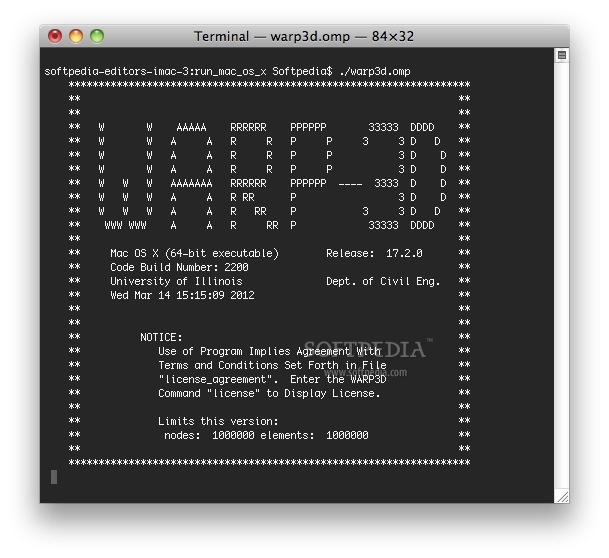
WARP3D is a command line application for static and dynamic nonlinear analysis of fracture in solids.
Some features in the code oriented toward the investigation of fracture in metals include a robust finite strain formulation, a general J-integral computation facility (with inertia, thermal, face loading), interaction integrals for computation of linear-elastic fracture parameters (stress intrensity factors and T-stress), very general element extinction and node release facilities to model crack growth, nonlinear material models including viscoplastic and cyclic, cohesive elements and cohesive constitutive models, hydrogen effects on plasticity, and the Gurson-Tvergaard dilatant plasticity model for void growth.
Detailed instructions on how to install and use the WARP3D utility on your Mac are available HERE.
WARP3D is a cross-platform utility capable of running on any operating system that comes with Java support (e.g. Mac OS X, Windows, Linux).
WARP3D 17.5.8
add to watchlist add to download basket send us an update REPORT- runs on:
- Mac OS X (-)
- file size:
- 171.5 MB
- filename:
- warp3d_distribution_17.5.8.tar.gz
- main category:
- Math/Scientific
- developer:
- visit homepage
IrfanView
ShareX
Zoom Client

7-Zip
4k Video Downloader

Microsoft Teams
Windows Sandbox Launcher
Context Menu Manager
Bitdefender Antivirus Free

calibre

- Context Menu Manager
- Bitdefender Antivirus Free
- calibre
- IrfanView
- ShareX
- Zoom Client
- 7-Zip
- 4k Video Downloader
- Microsoft Teams
- Windows Sandbox Launcher
