
A free and open source Java database that supports a wide array of formats and combines SQL and source code generation features.. #Database query #Database API #Query database #Query #Database #API
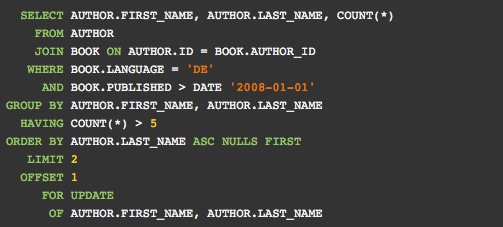
jOOQ effectively combines complex SQL, typesafety, source code generation, active records, stored procedures, UDTs, and Java in a fluent API.
Supported DBs are DB2, HSQLDB, MySQL, Oracle, Derby, Ingres, H2, Postgres, SQLite, SQL Server, Sybase.
· Your database always comes FIRST! That's where the real schema is, not in Java code or some XML mapping file, whose syntax you're not familiar with. · You keep your code DRY. · You won't suffer from the Object-relational impedance mismatch. · You won't have syntax errors in your query. · You won't forget to bind variables correctly. No SQL injection, either. · You don't need to know your database schema by heart when you develop. The schema is generated in Java. You can use auto-completion in your IDE! · You don't need to create value objects for your data. Use the generated artifacts instead. · You have automatic type mapping between SQL data types and Java types. · You change something in the database? Your Java code won't compile. You don't need to wait until runtime to notice. · You can forget about JDBC (especially useful when dealing with UDTs, ARRAYs and stored procedures). · You can port your SQL to a new database. jOOQ will generate SQL that works on any database.
System requirements
What's new in jOOQ 3.6.2:
- Bug fixes:
- #4162 - Malformed record literal when using PostgreSQL array of user-defined types
- #4248 - daoImplements option in MatcherStrategy not generating an implements statement in DAO class
- #4258 - Bad SQL generated for quantified row value expression predicates in Oracle
jOOQ 3.6.2
add to watchlist add to download basket send us an update REPORT- runs on:
- Mac OS X (-)
- file size:
- 13.1 MB
- main category:
- Developer Tools
- developer:
- visit homepage
calibre
4k Video Downloader

Microsoft Teams
Context Menu Manager
IrfanView

Windows Sandbox Launcher
Bitdefender Antivirus Free

ShareX
7-Zip
Zoom Client
- ShareX
- 7-Zip
- Zoom Client
- calibre
- 4k Video Downloader
- Microsoft Teams
- Context Menu Manager
- IrfanView
- Windows Sandbox Launcher
- Bitdefender Antivirus Free